You sit down to do one important task.
Before you start, you check your email “for a second.”
A message needs a reply.
While replying, you remember something else.
You open another tab.
Then a notification shows up.
Ten minutes later, you’ve produced nothing… but you already feel tired.
That feeling isn’t laziness. It’s not a character flaw.
It’s your brain hitting a real limit.
This post explains what “overwhelm” actually is, why it happens, and what you can do about it — in a way that doesn’t require turning your life into a robot schedule.
A quick note about why I’m writing this
I’m not a therapist and I’m not a motivational speaker.
I’m system-minded. I work in engineering and automation, and when something keeps failing, I don’t start by blaming the person — I look at the system.
I’ve felt overwhelm too. The brain fog, the noise, the feeling of being behind even when trying hard.
So I studied the mechanism, because I wanted a real explanation — not self-blame.
What overwhelm really is
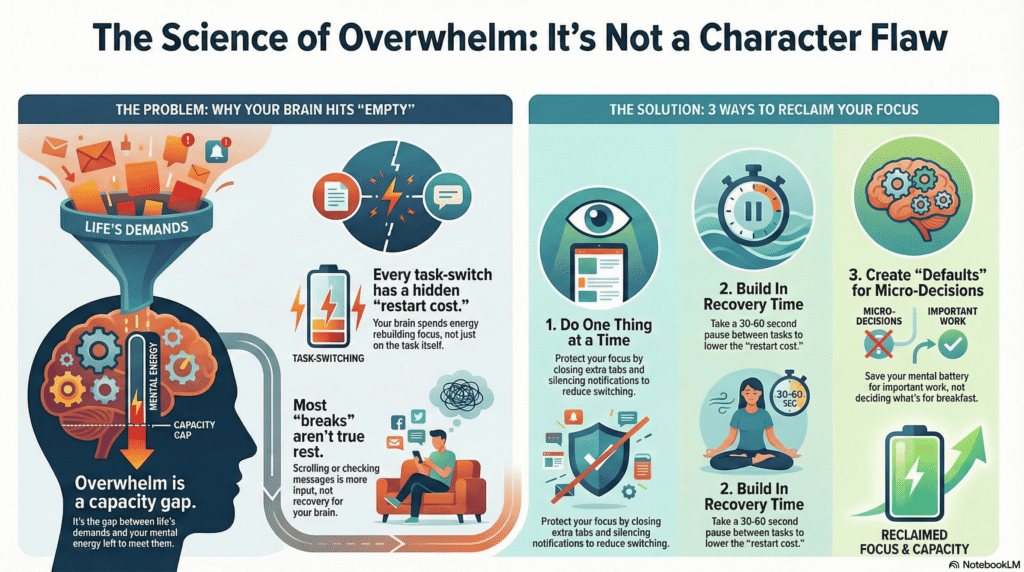
Overwhelm isn’t simply “I have too much to do.”
Overwhelm is:
Your brain is at zero… but the day is not.
It’s the gap between:
- what life is still demanding from you
and - how much mental capacity you have left to meet those demands.
So the real question is not “How do I do more?”
The real question is: Why does my capacity collapse so early?

The core mechanism: switching is expensive
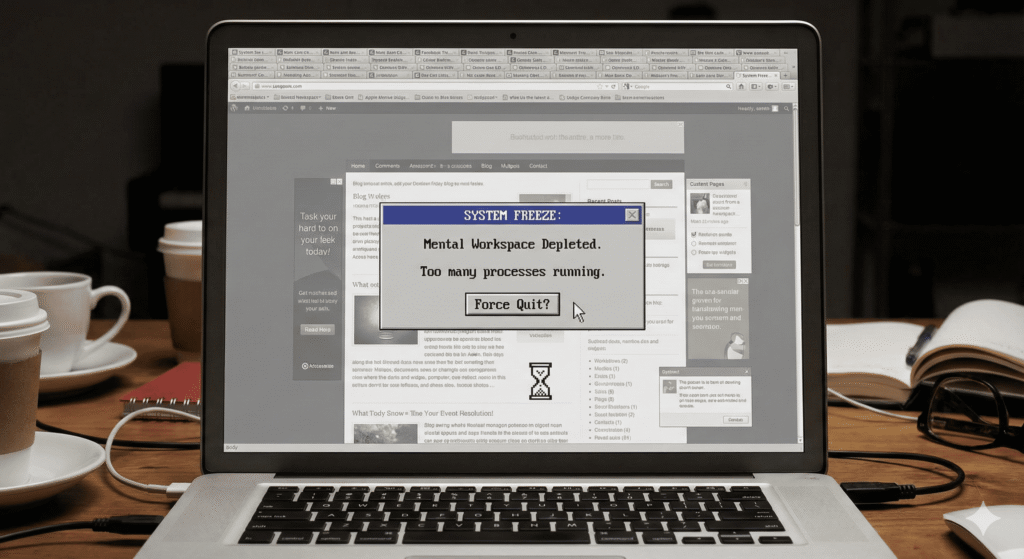
Your brain has a small workspace for active thinking.
You can only hold a few things clearly at one time.
When you switch tasks, you don’t reset to zero.
You carry leftovers from the previous task into the next one.
So Task A doesn’t end cleanly.
Task B starts on top of Task A.
Then Task C shows up.
By midday, your mind isn’t empty. It’s crowded with unfinished contexts.
This is why many people feel “busy all day” but nothing moves.
Not because they are weak — but because their attention is fragmented.
A practical example: the hidden “restart cost”
Imagine you’re writing a report.
Every five minutes a message arrives.
You don’t even reply — you just read it.
Your brain still has to do work:
- understand the message
- decide if it matters
- store it briefly
- then rebuild your mental focus on the report again
That rebuild is the real cost.
Switching isn’t free. It has a restart cost.
And after you switch, your brain needs recovery time to re-enter deep focus.
If you switch again before you recover, the cost stacks.
So the task starts feeling heavier and heavier — not because the work is harder, but because your fuel is being spent on restarting, not thinking.
This is where people feel:
- “brain fog”
- “I can’t think straight”
- “I don’t know where to start”
That’s cognitive overload, from the inside.
Why your “rest” doesn’t fix it
Most people try to recover by doing something else.
They scroll.
They watch short videos.
They check messages.
But that often isn’t rest. It’s more input.
Here’s a simple rule:
If your break makes you react, decide, compare, or respond… it’s not rest.
Real rest is when the brain stops processing demands long enough to recover.
If you never truly disengage, you return to work still depleted — and then everything feels overwhelming again.
Overwhelm is not just workload.
It’s workload plus unrecovered fatigue.
Why we blame ourselves
When clarity disappears, we assume a character problem:
“I’m not disciplined.”
“I’m lazy.”
“I should be able to handle this.”
But the sequence is mechanical:
Switching breaks focus.
Broken focus burns capacity.
Low capacity makes tasks feel impossible.
That feeling becomes overwhelm.
Your brain isn’t broken. It’s responding correctly to too much demand and too little recovery.
What you can do (practical, human, not robotic)
No long list of hacks.
Just three moves that reduce overwhelm at the source.
1) Do one thing at a time (and protect it)
Pick one task and finish it before starting the next.
Not perfectly. Just intentionally.
To make this real:
- close extra tabs
- silence notifications
- put your phone out of reach
- keep only what you need for the task
The goal isn’t productivity as a personality — it’s less switching, because switching is expensive.
2) If you must switch, build in recovery time
Sometimes switching is unavoidable. Fine.
But don’t jump instantly from one demand into another demand.
Between tasks:
- take 30–60 seconds
- breathe
- stand up
- drink water / coffee
- look away from the screen
- write one line: “Next step when I return is…”
That tiny pause is recovery time.
It reduces the restart cost and keeps your brain from overheating.
3) Stop burning your brain on repeated micro-decisions
This is not about becoming robotic.
It’s about stopping your mind from wasting energy on the same boring choices every day.
Create “defaults” for low-value decisions:
- what you eat for breakfast on weekdays
- when you check messages
- where you put keys, wallet, chargers
- how you start work (same first 2 minutes)
Not because life is a machine.
But because your brain is not an infinite battery, and you want more energy for what actually matters: people, learning, creativity, and peace.
The simple conclusion
If you want one direction, it’s this:
Decide what matters today — and do one thing at a time.
Remove distractions.
Finish one task, then move to the next.
And when you have to switch, remember:
Switching has a restart cost. Recovery time is part of the work.
Overwhelm isn’t a personality problem.
It’s a capacity problem.
Protect attention. Let it recover.
And clarity comes back.